
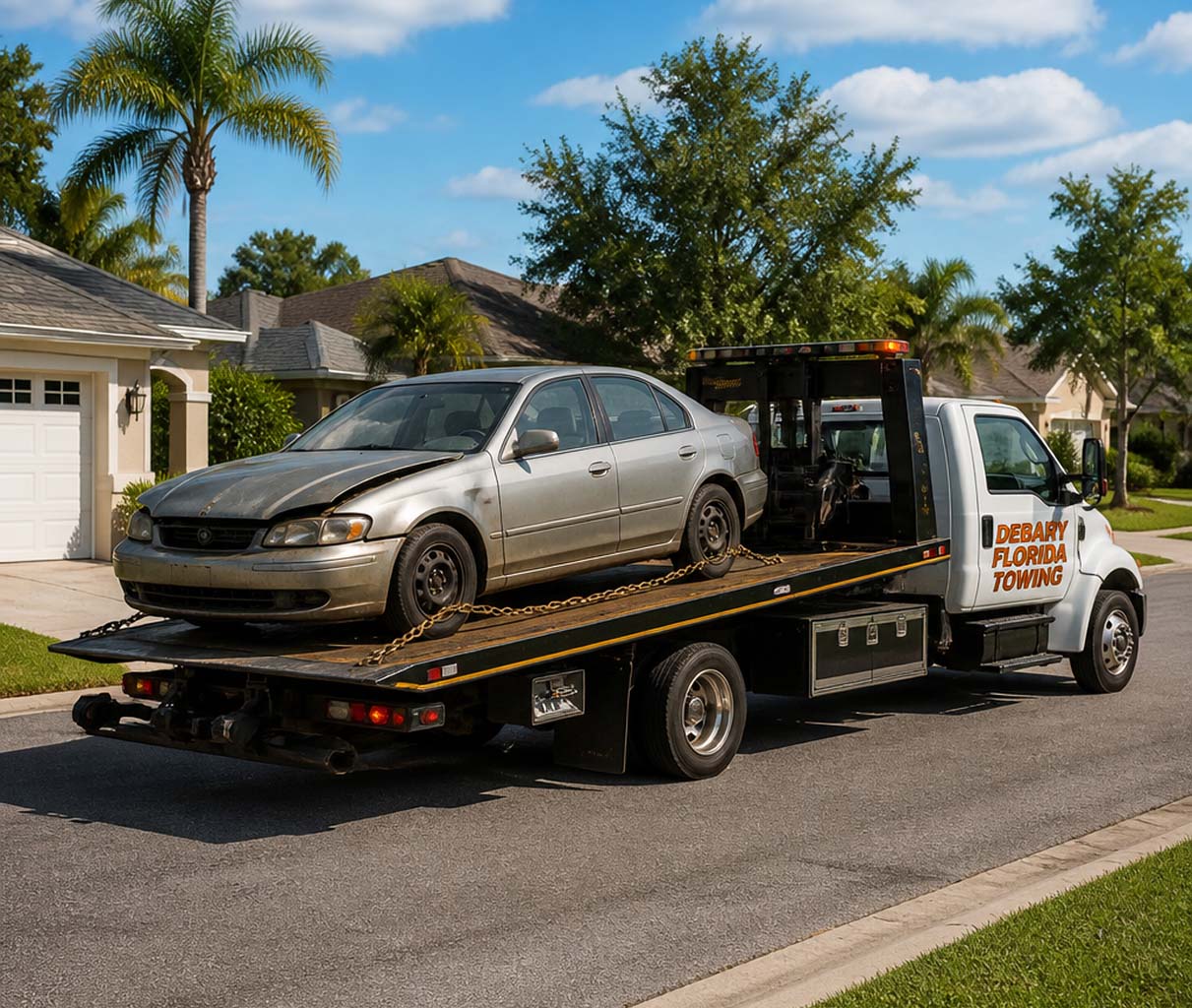
Key Takeaways
- A private property owner in Florida can have a vehicle removed without the owner's consent, but only after the property is signed correctly.
- The tow-away sign must use letters at least four inches high on a contrasting background, be mounted between three and six feet above the ground, and be in place at least 24 hours before a tow.
- The towing company must notify local law enforcement within 30 minutes of completing the removal.
- If the owner turns up while the car is being hooked, the operator has to stop and release it for no more than half the posted rate.
- Storage charges do not apply if the vehicle is in custody fewer than six hours, and a lien release administrative fee is capped at $250.
- If the derelict car is your own and you simply want it gone, none of this applies — that is a junk car removal, and the paperwork is a title, not a tow authorization.
Can You Have a Car Towed Off Your Own Property?
Yes, and Florida sets out exactly how. Florida Statutes section 715.07 lets the owner or lessee of real property have a vehicle removed without the vehicle owner's consent, provided the property carries the required notice and the removal follows the statute's procedure. The right belongs to the property owner, not the towing company, which is why a legitimate operator asks who you are before hooking anything.
The distinction that matters in a DeBary driveway is between a car that is trespassing and a car that is simply unwanted. A neighbor's relative parking across your driveway is a trespass-tow question governed by this statute. A dead sedan you bought in 2009 and stopped registering is your property, and removing it is a sale or a haul-away, not an enforcement action.
What Signage Does Florida Require Before a Tow?
The sign is the precondition, not a formality. Section 715.07 requires a notice posted at each driveway or curb cut reading "tow-away zone" in letters not less than four inches high on a contrasting background, on a permanently installed structure with that wording between three and six feet above ground level, maintained for at least 24 hours before a vehicle can be towed. Smaller lots with 20 or fewer spaces have an alternative format available.
Residential driveways and small properties are where this trips people up. Putting up a sign this afternoon does not authorize a tow this evening, and a laminated sheet taped to a fence post is not what the statute describes. If the signage is not right, the removal is exposed, and the property owner — not just the tow operator — can end up on the wrong side of it.
What Happens If the Owner Shows Up Mid-Tow?
The tow stops. Under the same statute, the operator must stop when a person seeks the return of the vehicle, and the vehicle is released for a reasonable service fee of no more than one-half of the posted rate. Once a vehicle has been taken to storage, it must be released to its owner within one hour of being requested.
Two other limits are worth knowing. The company must notify the local police department or sheriff's office within 30 minutes after the removal is complete, reporting the storage location, the time, and the vehicle details, and it must have its current rate schedule on file with law enforcement. Storage locations are also distance-limited from the point of removal, so a car cannot be taken across the county to make retrieval difficult.
Who Pays, and What Happens to the Car After That?
The vehicle's owner pays, and the towing company's claim on the car is a statutory lien. Florida Statutes section 713.78 requires the operator to send notice by certified mail within five business days after the date of storage, caps a lien release administrative fee at $250, and prohibits storage charges where the vehicle is in custody fewer than six hours.
If nobody claims it, the lien runs its course. The statute sets a waiting period before the vehicle can be sold — 35 days from storage for older vehicles and 57 days for newer ones — and gives the owner routes to get the car back in the meantime, including posting a bond with the clerk of court or filing in county court to contest whether the vehicle was wrongfully taken or the fees were improper. That timeline is why an abandoned car does not disappear from a lot in a week.
What If the Car Is on the Street, Not on Your Property?
A vehicle sitting on a public right-of-way is not yours to have towed, and the route is a call to law enforcement rather than to a wrecker. Florida Statutes section 705.103 gives officers a posting procedure for abandoned property: a weatherproof notice at least 8 by 10 inches goes on the vehicle, the owner has five days to remove it, and after that the agency may proceed with removal and disposal.
The costs follow the registered owner, not the neighbor who reported it. The statute makes the owner liable for removal, storage, destruction, and disposal costs, and ties unpaid amounts to their ability to obtain a vehicle registration. That is the practical reason a car rotting on a residential street off Highbanks Road eventually moves: the bill attaches to the person whose name is on the title, and it keeps growing while the car sits.
What If the Derelict Car Is Yours?
Then the process is far simpler, and none of the trespass-tow machinery applies. A vehicle you own can be hauled off your property whenever you decide, and the only real question is paperwork: a title in your name is the clean path, and without one you are looking at a duplicate title application before most buyers or removal services will take it.
Prepare it the way you would for any sale. Pull the plate, since the tag stays with you rather than the car, remove personal items from the trunk and glovebox, and note the vehicle's condition so the quote you are given matches what the driver finds. A car that has been sitting on grass for years is usually still worth something for scrap weight and parts, which is the difference between paying for disposal and being paid at pickup.
What the car is worth at that point comes down to a few concrete things rather than its old book value: curb weight, whether the drivetrain and catalytic converter are still in it, whether the wheels roll enough to winch it onto a deck, and whether anything on it is in demand as a used part. A complete vehicle that rolls is a straightforward pickup; one that has been stripped, sunk into soft ground, or parted out over several years is a harder job and quoted as one.
What to Settle Before the Truck Arrives
Almost every dispute in this area comes from skipping one question at the start: whose vehicle is it, legally, today. If it is someone else's, the signage and the notice requirements are not optional details, and getting them wrong turns a nuisance into your liability. If it is yours, the only thing standing between the car and the scrap yard is usually a title, and that is worth sorting out before you book anything.
The second thing to settle is where the car sits. A vehicle on grass, behind a gate, or boxed in by a fence changes the equipment that has to show up, and it is cheaper to say so on the phone than to have a truck arrive that cannot reach it. When it is your own dead vehicle going away for good, DeBary Towing handles that as junk car removal, and when it is a car blocking access that has to move now, emergency towing is the call to make instead.