
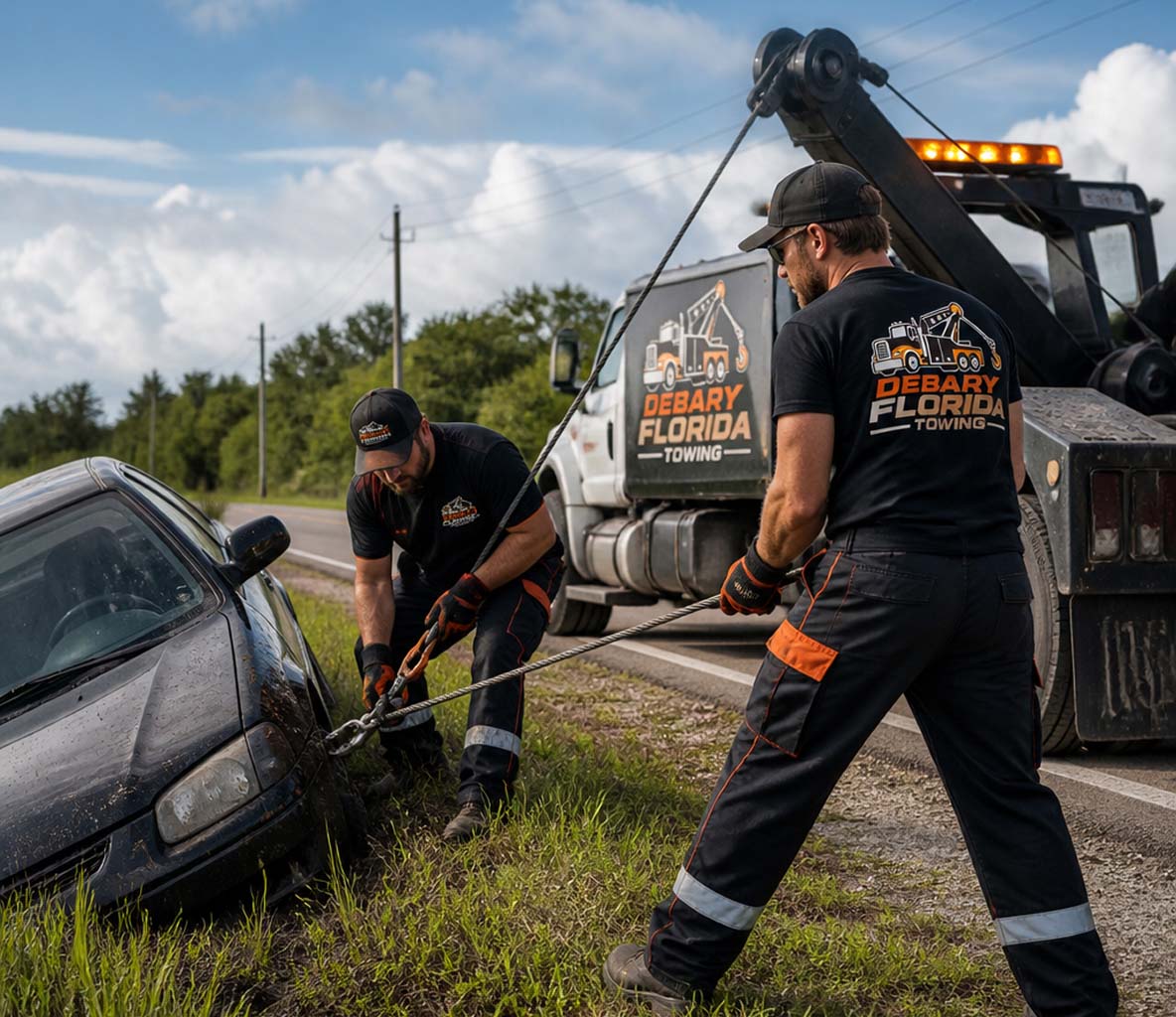
The ground on the west side of DeBary changes character fast. A packed two-track running toward the St. Johns River looks solid until the last hundred feet, where the surface turns to loose sand that a passenger car floats on top of right up until it doesn't. Add an afternoon of wet-season rain and the same approach becomes a rut that grabs a tire and holds it.
Getting a car stuck in sand or mud is rarely a driving mistake so much as a surface-reading mistake, and what you do in the first minute decides whether this ends with a push or with a winch line. Here is the order to work through.
1. Stop Spinning the Tires Immediately
The single most useful thing you can do is take your foot off the accelerator. A spinning tire polishes sand into a bowl and turns mud into a slick trench, and it does that in seconds, not minutes. Every rotation after traction is lost digs the car deeper and makes the eventual recovery harder.
Get out and look before you try anything else. If the tire is still sitting on top of the surface with its tread visible, you have options. If the sidewall has disappeared and the chassis is resting on the ground, the car is no longer being held by the tires at all, and nothing you do from the driver's seat will change that.
2. Work Out What You Are Actually Stuck In
Sand and mud fail in opposite ways, and the fix differs. Central Florida's dry uplands are built on deep, excessively drained sands: the Astatula series, widespread across the Florida peninsula, runs as sand and fine sand to depths of 80 inches or more with less than 5 percent silt and clay. There is no firm layer a few inches down to reach. Digging in that kind of sand mostly relocates it.
Mud near the river floodplain behaves differently. It has structure, it holds water, and it grips. A car in mud is usually held by suction and by a rut wall, which means clearing a ramp in front of each driven wheel can genuinely work where the same effort in dry sand will not.
3. Check Where the Car Is Sitting Before You Dig
Look underneath the vehicle and behind it before you commit to a self-recovery attempt. Three things matter: whether the frame or exhaust is bearing weight on the ground, whether the driven wheels are the ones buried, and whether the ground behind you is firmer than the ground ahead.
If the undercarriage is resting on a hump of sand, the tires have already lost most of their load and traction is gone regardless of how much throttle you use. Reversing along your own tracks, where the surface is already compacted, is almost always a better bet than pushing forward into ground no wheel has touched.
4. Try the Two Moves That Rarely Make Things Worse
Two techniques are worth attempting because neither one digs you deeper if it fails. The first is lowering tire pressure modestly to widen the contact patch, which helps a car float on soft sand instead of cutting into it. Only do this if you can reinflate afterward, since driving any distance on badly underinflated tires damages them.
The second is building a traction surface. Floor mats, a folded tarp, palm fronds, or boards wedged hard against the front of the driven tires give the tread something solid to bite. Pair either move with the gentlest possible throttle and a straight steering wheel, and stop the moment the tires start to spin rather than roll.
5. Recognize When the Attempt Is Over
Stop self-recovering when any one of these is true: the car has settled onto its frame, the tires are buried past the sidewall, water is rising around the wheels, or the vehicle has slid toward a slope, a canal bank, or the river edge. At that point more effort produces more damage, not more progress.
Two other stop signals get ignored a lot. If you are on a soft shoulder where passing traffic is close, standing beside the car to dig is the real hazard, not the stuck car. And if the wet season has the ground saturated — the National Weather Service puts the median start of the wet season at Sanford, just across Lake Monroe, at May 27, with the dry season beginning around October 15 — the ground under a stuck car can keep softening while you work on it.
6. Understand What a Winch-Out Recovery Involves
A winch-out recovery pulls the vehicle out under controlled tension rather than yanking it. The operator first looks for an anchor and a pull line that matches the direction the car went in, because dragging a vehicle sideways across a rut loads the suspension and body in ways they were not designed for. Straps go to rated recovery points on the frame, never to a bumper, control arm, or tie rod.
From there it is slow and deliberate. The winch takes up tension, the car moves a few inches, the operator checks the line and the ground, and the sequence repeats. Snatch blocks let the pull be redirected around an obstacle when the truck cannot line up directly. Once the vehicle is back on firm ground, it is worth checking the underside for packed sand around the brakes and exhaust before driving away, which is the part a roadside rescue by a friend with a rope usually skips.
7. Turn Down the Well-Meaning Bystander Pull
The most common way a stuck car becomes a damaged car is a rope between two bumpers. A modern bumper cover is plastic over a reinforcement bar bolted to crush cans engineered to collapse in a collision, not to take a lateral yank, and tow-hook eyelets that thread into the bumper are rated for loading onto a flat deck, not for dragging a buried vehicle out of a rut.
The dynamic version is worse. A pickup taking a running start at the end of a strap converts its momentum into a shock load, and when something lets go, the hardware travels back along the line at speed. Recovery straps and shackles carry working load ratings for exactly this reason, and a ratchet strap or a chain from a toolbox has none that apply. If a stranger offers to snatch you out, the polite answer is that the car is going out under a controlled pull.
8. Know the Cost of Leaving It There
Abandoning a stuck vehicle to deal with later can turn an inconvenience into a bill. Under Florida Statutes section 705.103, a vehicle left on public property can be posted with a notice at least 8 by 10 inches, and if it is not removed within five days, the agency may proceed with removal and disposal.
The statute makes the owner liable for the costs of removal, storage, destruction, and disposal, and it ties unpaid costs to your ability to get a vehicle registration. A stuck car retrieved the same evening is a recovery job. The same car left through the weekend on a public access road can become a removal action with a longer invoice attached.
Before You Touch the Gas Pedal Again
The factor that settles most of these situations is what the driven wheels are resting on, and you can only learn that by getting out and looking. Loose DeBary sand rewards flotation and punishes throttle; river-edge mud rewards clearing a path and punishes patience. When the undercarriage is carrying weight, neither applies, because the tires are no longer doing the work and no amount of technique changes that.
One practical habit is worth more than any recovery trick: walk the last stretch of soft ground before you drive it, especially after a wet-season afternoon. If you do end up buried past the sidewalls near Gemini Springs or on a sand track off Highbanks Road, that is the point to call DeBary Towing for an off-road recovery and winch-out rather than digging, and to ask for emergency towing instead if the car is stuck somewhere traffic is moving past it.