
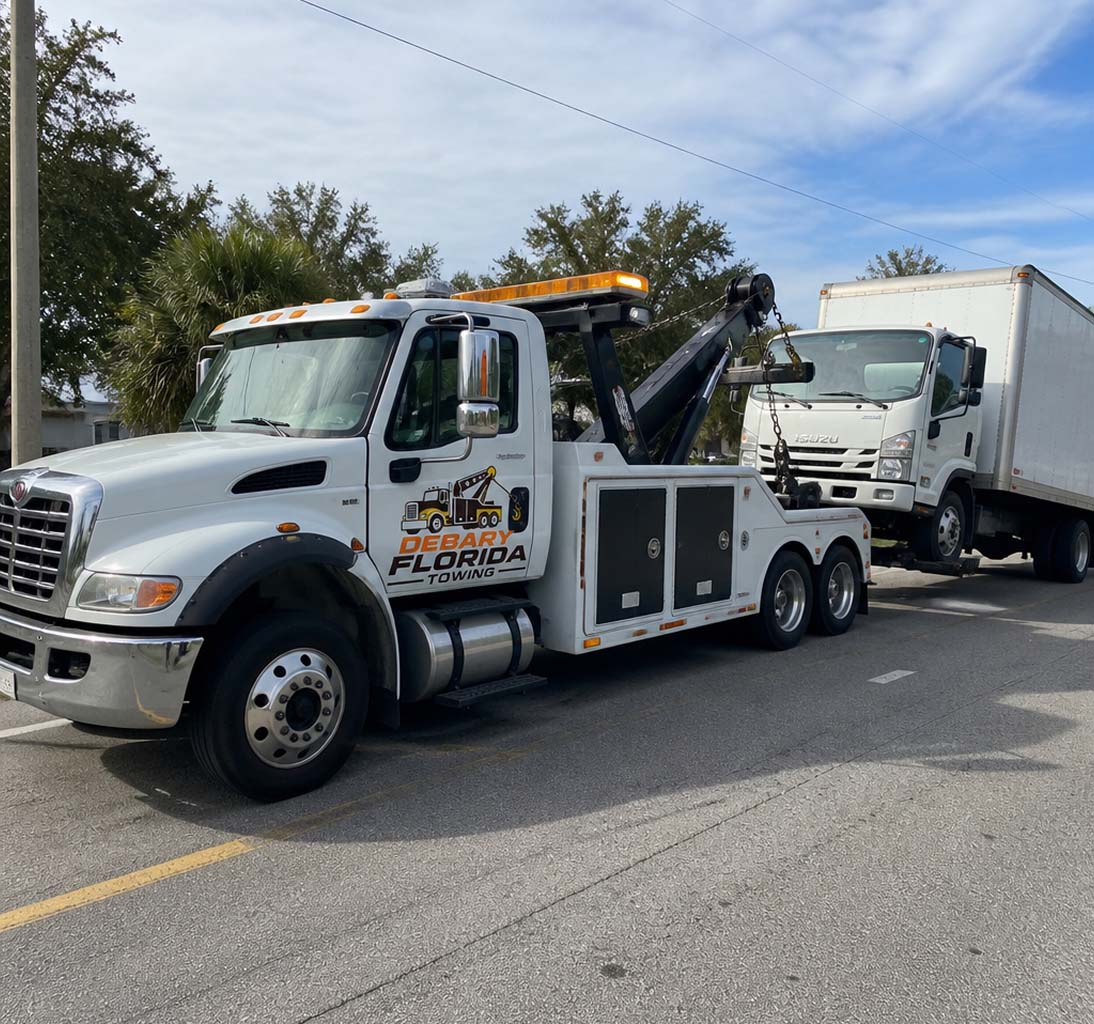
I-4 runs along the southern edge of DeBary, and the stretch between the Saxon Boulevard and Dirksen Drive interchanges carries a steady mix of commuter traffic and freight moving between Orlando and Daytona. When one of those trucks leaves the pavement, the response looks nothing like a car being hooked and driven away.
A loaded tractor-trailer can weigh 40 tons, and the recovery is a controlled engineering job with traffic management wrapped around it. Here is what is actually happening while you sit in the backup.
The First Priority Is Traffic, Not the Truck
Before anything gets lifted, the scene has to stop being a second crash waiting to happen. Lane closures, cones, and advance warning go in first, because a stationary work area beside a 70 mph travel lane is the most dangerous part of the whole job for everyone standing in it.
Florida runs a state service patrol for exactly this. The Florida Department of Transportation's Road Rangers program provides no-cost highway assistance and traffic incident management on congested and high-incident stretches of freeway, including removing disabled vehicles from travel lanes, clearing debris, and providing traffic management support during incidents. They are often the first units on scene while a heavy wrecker is still en route.
Heavy Recovery Is Slow Because Guessing Is Expensive
A heavy recovery begins with an assessment that can take longer than the lift. The operator needs to know the loaded weight, where the center of gravity sits, whether the trailer is still coupled, what the ground under the rig will support, and whether the cab has occupants or fuel leaking from a saddle tank.
Getting that wrong has consequences a car recovery does not have. Lift a loaded trailer at the wrong point and the frame bends; pull it sideways and 40 tons can roll onto the crew. The slow, methodical pace you are watching from the queue is the part that keeps a bad morning from becoming a fatal one.
The Load Usually Comes Off Before the Truck Does
Recovering a loaded trailer often means unloading it first, sometimes onto another trailer brought to the scene. A shifted load changes the center of gravity, and an overturned trailer full of freight is far heavier than the rigs on site can safely upright in one piece.
Cargo is regulated in its own right. Federal rules at 49 CFR 393.100 require cargo to be contained, immobilized, or secured so it cannot leak, spill, blow, or fall from the vehicle, and so it cannot shift in a way that affects stability or maneuverability. When securement fails, the debris field becomes part of the recovery, and in Florida that can mean a lane of produce, building materials, or landscaping stone that has to be collected before traffic moves.
Rigging Is Where the Expertise Actually Sits
The wrecker gets the attention; the rigging does the work. Recovery crews run winch lines to structural points on the frame, use snatch blocks to redirect a pull when the truck cannot line up with the load, and often work two or three machines together — a rotator lifting while a second wrecker controls the swing.
Rating discipline governs every piece of it. Every strap, shackle, and chain carries a working load limit, and the assembly is only as strong as its lowest-rated component. This is the difference between a recovery and an improvisation, and it is why a heavy job takes specialized equipment rather than a bigger version of a car tow truck.
Size and Weight Rules Shape the Route Out
Once the rig is upright, it still has to leave, and Florida sets hard limits on what can move on the highway. Under Florida Statutes section 316.550, moving a vehicle or load that exceeds legal size or weight requires a special permit from the Department of Transportation or the local authority, the permit names the specific vehicle, load, and highways covered, it must be carried and shown on demand, and routes must avoid bridges that cannot safely carry the weight.
That is why a damaged truck is not simply dragged to the nearest lot. A wrecked trailer riding on a recovery rig can exceed normal dimensions, so the route to the yard is a decision made against permit conditions and bridge ratings, not convenience.
What Car Drivers Should Do When They Come Up on One
Treat the scene as a work zone with people standing in it. Move over a lane when you safely can, slow down well before the cones rather than at them, and do not stop on the shoulder to watch, because the shoulder is where the crew walks between the truck and the equipment.
If you are stuck in the resulting backup on a summer afternoon, keep the engine running for air conditioning if traffic is fully stopped, watch your temperature gauge, and leave space ahead so you can be moved if emergency vehicles need to come through. Exiting at Saxon or Dirksen and taking US 17-92 is frequently faster than waiting, since a heavy recovery is measured in hours rather than minutes.
Where the Truck and the Freight Go Afterward
The recovery ends at a yard, but the freight rarely stays with the truck. A load that is still sound gets transferred to a replacement trailer so it can continue to its delivery, sometimes the same day, because a shipper waiting on it is the reason the truck was on I-4 in the first place. Damaged freight is separated, documented, and dealt with as a claim.
The tractor and trailer go to a secure lot to await an insurance adjuster, and that is where the recovery's paperwork matters. Photographs of the scene, the rigging, and the damage as found are what the carrier, the insurer, and any investigator work from later. A recovery done by a crew that keeps that record is worth more to the trucking company than the hour it might have saved by skipping it.
On the dispatch side, the weight class decides everything before a truck leaves the yard. A loaded semi or a bus needs rigs rated for the tonnage, which is what heavy-duty towing from DeBary Towing sends, while a blocked lane with a lighter vehicle in it is an emergency towing call. Giving dispatch the vehicle type, the loaded weight, and the mile marker is what gets the right equipment rolling the first time.
Common Questions About Heavy-Duty Recovery
How long does a heavy-duty recovery take?
Hours, not minutes, and the assessment and rigging usually take longer than the lift itself. A straightforward upright tow of a disabled truck can be quick, while an overturned loaded trailer that has to be unloaded on scene can occupy a lane for most of a day. The variables are load, terrain, and whether the cargo has spilled.
Can a regular tow truck move a semi or a box truck?
No. A light-duty wrecker is not rated for the weight, and attempting it damages both vehicles and puts the crew at risk. Medium and heavy-duty work needs rigs rated for the tonnage, with the boom, winch, and underlift capacity to match — which is why dispatch asks for the vehicle type and loaded weight before sending a truck.
Who pays for a commercial recovery on I-4?
Generally the motor carrier or its insurer, through the commercial policy on the truck, rather than the driver personally. Where a crash is involved, responsibility for the recovery and any cargo handling is worked out between the carriers and insurers afterward. That billing question does not delay the recovery itself, which proceeds on safety and traffic grounds.
Does a disabled truck have to be moved out of the travel lane immediately?
Yes, whenever it can be done safely, because a blocked travel lane on an interstate is the highest-risk condition at the scene. Road Rangers and law enforcement prioritize getting vehicles out of live lanes, even to the shoulder, before any full recovery begins. Complete removal of a heavy vehicle then follows at the pace the equipment and rigging allow.