
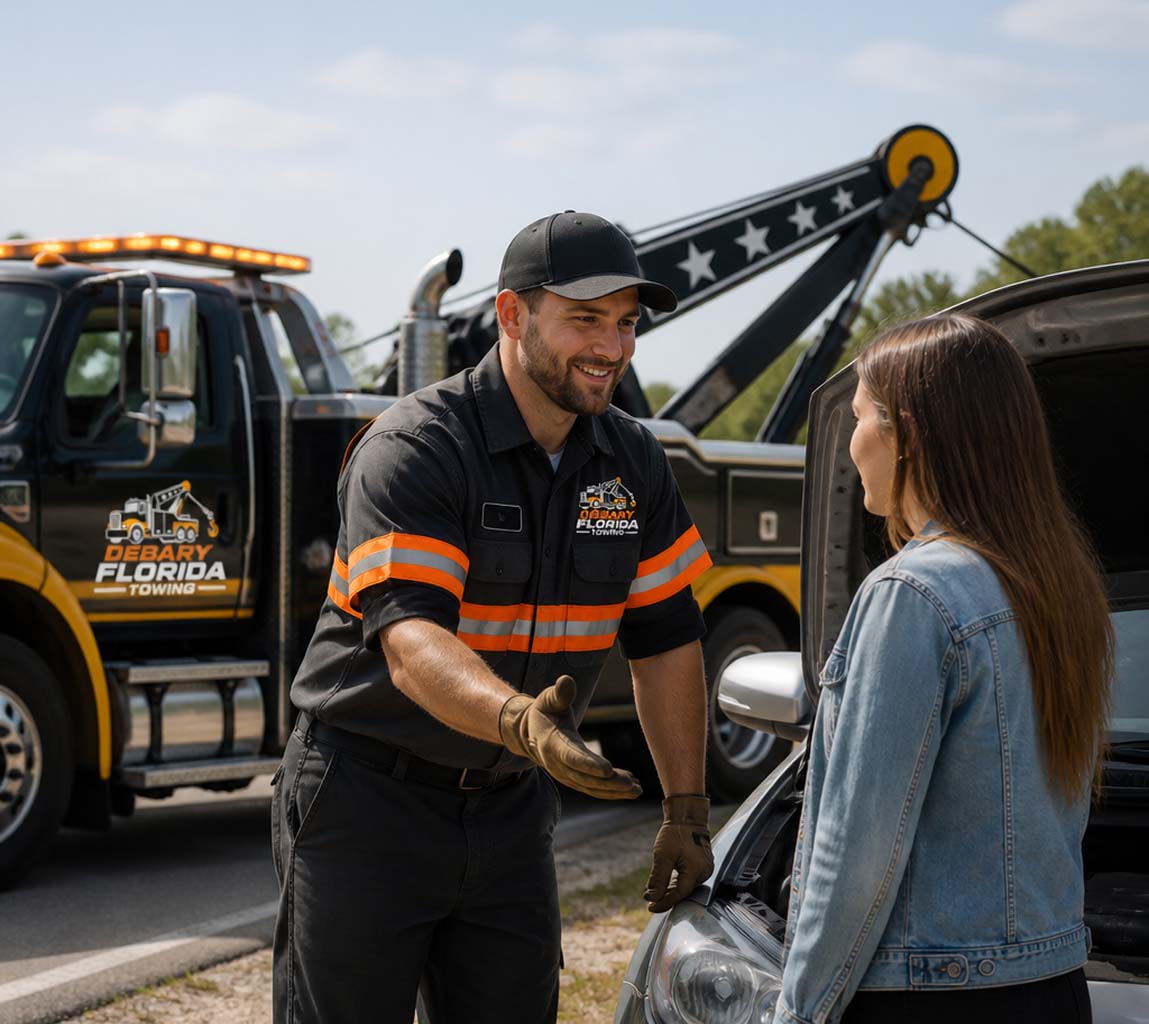
- A donut spare is a temporary fix, not a replacement tire, built to reach a shop rather than keep driving on.
- Keep your speed at or below the limit stamped on the spare's sidewall, usually 50 mph, and drive the shortest distance you can.
- Most carmakers suggest a compact spare is good for roughly 50 to 70 miles before you fit a real tire; your owner's manual lists your car's number.
- A donut's shallow tread grips poorly in Florida rain, so I-4 and a wet US 17-92 are the worst places to rely on one.
- Check your spare's air pressure every month: a donut runs near 60 psi and loses air in storage, especially in Volusia County's heat.
- All-wheel-drive and some four-wheel-drive vehicles can be damaged by a mismatched donut, so a flatbed tow is the safer call.
You are on US 17-92 heading into DeBary, a tire lets go, and once the donut is bolted on you have a decision: how far can you drive on a donut spare, and how fast is safe? The short answer is not far, and not fast. A compact spare, the skinny donut tucked under your trunk floor, is engineered to get you off the shoulder and to the nearest tire shop and nothing more. Lean on it like a normal tire and you invite a second breakdown, a traffic stop, or real driveline damage.
How far and how fast can you drive on a donut spare?
A donut spare is safe for a short, slow trip to a tire shop, not for daily driving. The number that matters most is stamped on the tire itself: most compact spares carry a molded Maximum 50 MPH warning on the sidewall, and owner's manuals generally repeat that cap alongside a distance guideline of roughly 50 to 70 miles. Those figures are not arbitrary. The spare is narrower, has shallower tread, and spins at a different rate than your full-size tires, so the longer and faster you run it, the more you stress the tire and the rest of the drivetrain. The rule is simple: drive straight to a shop, stay under the sidewall's speed, and swap the donut for a proper tire the same day. If the nearest open shop is far, or it is late at night, a tow often beats nursing a donut across the county.
Why a donut spare is built to be temporary
A compact spare is small and light to fit a shrinking trunk, and every one of those compromises limits how you can use it. Its diameter is smaller, so it rotates faster than the other three tires to cover the same ground, and that mismatch is what confuses anti-lock brakes, traction control, and all-wheel-drive systems. The tread is shallow and the contact patch is narrow, so braking distances grow and grip drops, most of all on a wet road. The higher inflation pressure stops the little tire from flexing under the car's weight, but it also makes for a harder, twitchier ride. None of this makes a donut unsafe for its intended job; it explains why temporary is printed on it.
Donut vs. full-size spare vs. run-flat: what you have
Know which spare your car carries, because not every vehicle has the same one.
| Spare type | Typical speed limit | Typical distance | Good to know |
|---|---|---|---|
| Compact donut spare | About 50 mph | About 50 to 70 miles | Lightweight with shallow tread; temporary only |
| Full-size spare | Normal driving speed | Until you can rotate it back in | Matches your tires, but still check its age and pressure |
| Run-flat tire | About 50 mph when deflated | About 50 miles after a puncture | No spare in the trunk; get to a shop promptly |
| Sealant or inflator kit | Normal once sealed | Small punctures only | Will not fix a blowout or sidewall damage |
Knowing which of these you have changes your plan on the shoulder. A full-size spare buys you time, while a donut, a run-flat, or a sealed tire all point you toward a shop today. If your car came with no spare at all and the puncture is a gash rather than a nail, roadside sealant will not save you, and a roadside tire change or a tow is the only real fix.
The DeBary roads where a donut is riskiest
The most dangerous place to use a donut near DeBary is Interstate 4. I-4 is posted at 70 mph through Volusia County, a full 20 mph above what most donuts allow, and trying to keep pace with traffic on a compact spare is exactly the misuse the sidewall warns against. If you blow a tire on I-4, reaching the shoulder and calling for help is far safer than limping along in the right lane while trucks pass at 75. Surface roads like US 17-92 are a better route for a slow crawl to a shop, but Florida's afternoon storms add a hazard: a donut's thin tread channels water poorly, so standing water on an Orange City or DeLand road can push a compact spare toward a skid faster than a full tire would. Under Florida Statute 316.610, it is unlawful to drive a vehicle in such unsafe condition as to endanger people or property, and the statute treats worn tires as the kind of defect that needs fixing. Keep the trip short, slow, and off the interstate.
Check your spare before you ever need it
The time to inspect a donut is in your driveway, not on the shoulder of I-4. A compact spare typically needs around 60 psi, far more than the 32 to 35 psi in your road tires, and that number is printed on the spare itself. Spares lose air just sitting in the trunk: the U.S. Tire Manufacturers Association notes that pressure changes about one to two psi for every 10-degree shift in temperature, so a donut that sat through a cool winter can read low, and Volusia County's long, hot summers only widen the swing. Both NHTSA and the Florida Highway Safety and Motor Vehicles department recommend checking every tire, the spare included, once a month when the tires are cold, and FLHSMV adds that any tire more than six years old should be replaced no matter how it looks. Note the pressure, note the age, and keep the jack and lug wrench with the tire.
AWD and four-wheel drive: the extra risk
If you drive an all-wheel-drive crossover or SUV, a donut carries a risk a front-driver does not. Because the compact spare turns at a different speed than the full-size tires, it forces the center differential and transfer case to work constantly to reconcile the mismatch, and over enough miles that can mean expensive driveline damage. Many all-wheel-drive and four-wheel-drive owner's manuals warn against using a compact spare at all, or cap it at very low speed and distance. If your manual says so, or if you are not sure, do not gamble the drivetrain on a cheap temporary tire; put the car on a flatbed instead. A flatbed tow lifts all four wheels clear of the road, so nothing spins and nothing binds, and your AWD system never knows the difference.
When a flat means calling a tow, not fitting the donut
Sometimes the donut is the wrong tool and a tow is the right one. Skip the spare and call for help when there is no spare in the trunk, when the donut itself is flat, cracked, or years past its prime, when more than one tire is damaged, or when you are on I-4 in fast traffic or stranded after dark. An AWD vehicle, a long haul to the only open shop, or discomfort changing a tire on a live shoulder also points to a truck. Roadside assistance can often mount your good spare for you on the spot, and when the spare cannot safely carry the car, DeBary Towing will flatbed it to the shop you choose. Weigh the cost of one tow against a ruined transmission or a second breakdown, and the call usually makes itself.
Donut Spare Questions DeBary Drivers Ask
Is it safe to drive on a donut spare on I-4?
It is risky and best avoided. I-4 is posted at 70 mph through Volusia County, while most donuts are limited to about 50 mph, so you cannot safely keep pace with traffic. If you flat on I-4, reach the shoulder, fit the spare only if you can exit quickly, and otherwise call for a tow.
How many miles can I drive on a donut spare?
Plan for roughly 50 to 70 miles, and check your owner's manual for your car's exact figure. The donut is meant to reach the nearest tire shop, not to serve as a daily tire, so cover the shortest distance you can and replace it the same day.
How fast can you drive on a donut spare?
Keep your speed at or below the limit molded into the spare's sidewall, which is usually 50 mph. Higher speeds overheat the small tire and strain your brakes and drivetrain, and they make the car harder to control in Florida rain.
What air pressure should a donut spare have?
Most compact spares call for about 60 psi, printed on the tire itself, far above a standard road tire. Because spares lose air in storage, check the pressure monthly when the tire is cold so the donut is ready before you ever need it.
Can I use a donut spare on an all-wheel-drive vehicle?
Often you should not. A mismatched donut can damage an AWD or four-wheel-drive driveline, and many manuals warn against it, so check yours first. When in doubt, a flatbed tow keeps all four wheels off the ground and protects the system.