
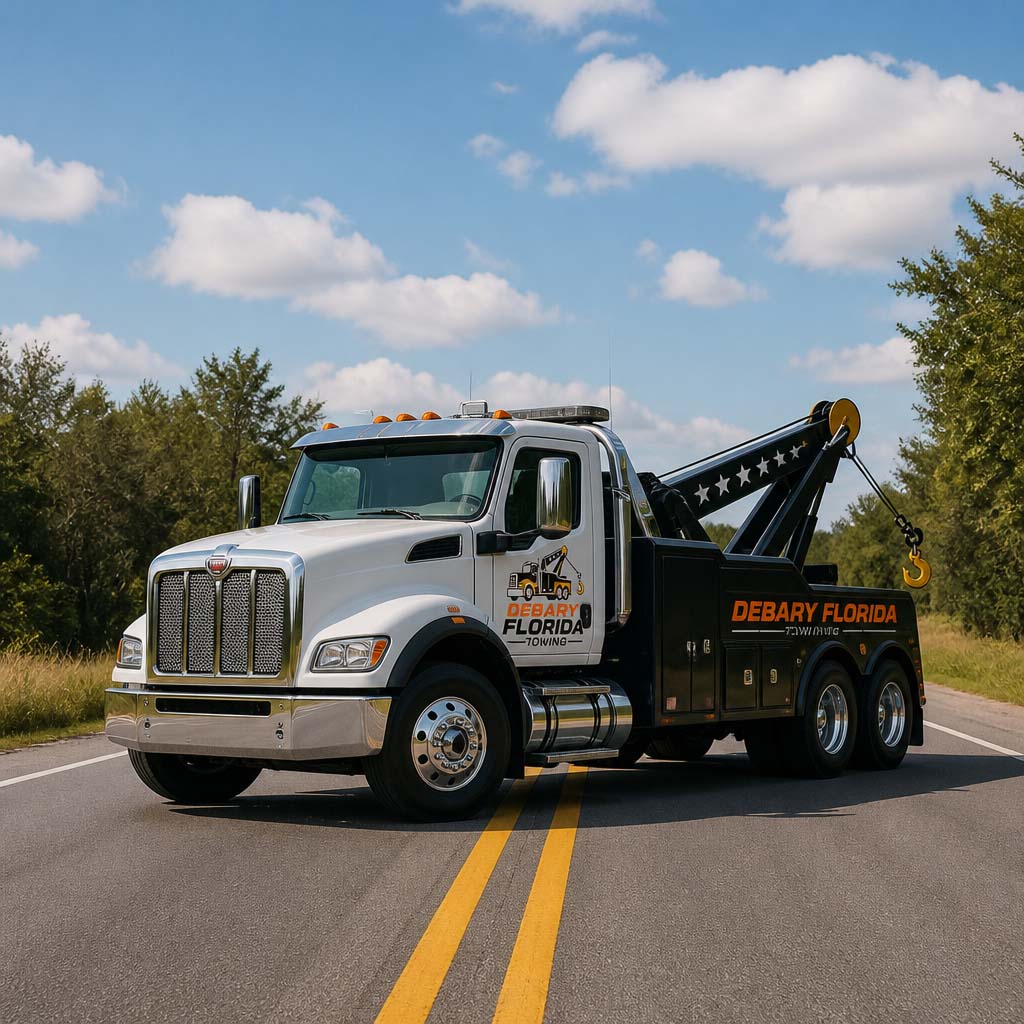
Moving a car from DeBary to another state has two very different answers, and they are priced, scheduled, and regulated differently. One is a long-distance tow: a truck comes to you, takes your vehicle, and drives it to the destination. The other is auto transport, where your car is booked onto a carrier hauling seven to ten vehicles at once, usually through a broker.
People shop them against each other on price alone and then get surprised by the parts that are not price. Here is what actually separates them, and which one fits which situation.
A Long-Distance Tow Is a Dedicated Trip
A long-distance tow is one truck making one trip for your vehicle. The company quotes a rate for that route, sends a flatbed or a wrecker, loads your car, and drives it. Nothing waits on other customers, because there are no other customers on that load.
The consequences follow from that. You get a date you choose rather than a window, the vehicle is handled by one crew from pickup to drop-off, and a non-running car is a normal job rather than an exception. The cost is that you are paying for the whole truck and the driver's time, including the return leg, which is why the per-mile figure looks higher than a shipping quote.
Car Shipping Is a Shared Load Sold Through a Middleman
Auto transport puts your car on a multi-car carrier alongside other people's vehicles, and the company you booked with is often not the company that shows up. Most consumer-facing auto transport sites are brokers: they collect your order and post the route to a network of carriers until one accepts it.
That structure is what makes the price lower per mile, and it is also where the friction lives. Pickup and delivery come as multi-day windows because the carrier is assembling a full load along a route. Your quote can be re-priced if no carrier takes the job at the posted rate. And the driver who arrives works for a company you have not vetted, unless you go and look them up.
Four Differences That Decide It
On schedule control, the tow wins: a set pickup time versus a window that can move. On cost per mile, shipping wins, and the gap widens the farther you go, because the carrier is splitting the trip across eight or nine cars.
On vehicle condition, the tow wins again. A car that does not run, does not roll, or does not steer needs winching onto the deck, and many open carriers are not equipped or willing to do it. On accountability, the tow is simpler: one company, one contract, one crew. Shipping adds a broker layer between you and whoever physically has your car.
Check the Authority Before You Book Either One
Any company hauling your car across a state line for money is federally registered, and you can check it in about two minutes. The Federal Motor Carrier Safety Administration requires a USDOT number for vehicles rated at 10,001 pounds or more operating in interstate commerce, and separately requires operating authority for companies that transport regulated commodities owned by others or arrange for their transport — that second clause is what covers brokers.
Ask for the USDOT or MC number before you pay a deposit, then look it up. FMCSA's SAFER Company Snapshot is free and searchable by company name, USDOT number, or MC number, and it returns the company's identification, size, safety record, and inspection history. A broker that will not give you the carrier's number until the truck is already scheduled has told you something useful.
How Your Car Has to Be Secured Once It Is Loaded
Securement is not left to the driver's judgment. Federal rules at 49 CFR 393.100 require that cargo on a commercial vehicle be contained, immobilized, or secured so it cannot shift in a way that affects the vehicle's stability or maneuverability, and so nothing leaks, spills, blows, or falls off in transit.
In practice that means wheel straps or chains at rated attachment points, checked before departure and again during the trip. It is worth watching how your car is tied down on either service. Straps run over a suspension component instead of the wheels, or a single chain doing the work of four, are the visible version of a securement problem.
Open Deck, Enclosed Trailer, or Flatbed
The equipment question cuts across both services. An open multi-car carrier is the cheapest and by far the most common, and it exposes the vehicle to road spray, sun, and whatever comes off the truck ahead of it for the length of the trip. An enclosed trailer costs substantially more and is what collectors and low-clearance cars use, because nothing touches the vehicle except the ramps and the straps.
A single-car flatbed sits between them in exposure and above them in flexibility. It loads at ground level with a tilting deck, which matters for a car with a low front lip or a dead battery, and it can deliver to a residential street that a 75-foot car carrier cannot legally or physically enter. That last point catches people out: multi-car carriers routinely ask you to meet them at a shopping center, because the rig cannot negotiate a subdivision.
Who Answers If the Car Arrives Damaged
Settle this before the vehicle is loaded, not after it lands. Ask the company for proof of cargo coverage in writing and confirm whether the policy sits with the broker or the carrier that physically hauls the car, because a broker's certificate does not necessarily cover a truck it subcontracted to.
Then build your own record. Photograph every panel, the wheels, the roof, and the odometer in daylight before loading, and get a signed condition report from the driver at both ends. A damage claim on an interstate move turns on documentation from the pickup, and a photo set taken in a DeBary driveway ten minutes before the straps went on is worth more than any recollection a month later.
When the Tow Is the Right Call From DeBary
The tow wins whenever timing, condition, or distance works against the shared-load model. A car that has to leave before a closing date, a move where you are driving the household vehicle and the second car must arrive the same week, or a vehicle that has been sitting in a driveway off Fort Florida Road for two years and will not roll onto a ramp — all of those are tow jobs.
Shorter interstate runs favor the tow too. On a trip from Volusia County up to Georgia or across to the Panhandle, the shipping discount has less distance to accumulate over, while the broker's scheduling window stays the same length. Somewhere past a thousand miles the math usually flips, and a multi-car carrier becomes hard to beat on price if your dates are flexible.
The Question That Settles It
Ask yourself what you are least able to absorb: an extra few hundred dollars, or an extra four days of not knowing when the truck arrives. If the answer is the money and the car runs, book the shared carrier, verify its authority, and plan for a window rather than a date. If the answer is the uncertainty — or the car does not run, or it has to be somewhere on a specific day — the dedicated trip is what you are actually buying, and comparing it to a shipping quote is comparing two different products.
For a vehicle leaving DeBary on a date that cannot move, or one that has not started in years, long-distance towing from DeBary Towing is the version of this with one company answering for the whole trip. If it needs to come off a driveway or a lot first, flatbed towing handles the loading end without asking the car to roll.