
A tire blowout is the sudden loss of air from a tire at speed, and it turns a routine drive into a few seconds that decide everything. On I-4 or US 17-92 near DeBary, a tire can let go at 70 miles per hour with a bang, a hard pull to one side, and a car that suddenly wants to change lanes on its own. What you do in the next few seconds matters more than anything you did before the tire failed. This guide covers why blowouts happen, how to keep the car straight when one does, where to stop along west Volusia County's busiest roads, and how to tell a roadside fix from a tow.
Key Takeaways
- A blowout is sudden air loss at speed; the safe reaction is to hold the wheel straight and ease off the gas, not to brake hard.
- Underinflation is the most common cause of tire failure, and NHTSA reports most drivers do not keep their tires at the right pressure.
- Florida's long hot season and hot pavement raise the risk, because heat builds fastest in a tire that is already low on air.
- A tire worn to 2/32 of an inch is legally worn out, and the penny test catches it before it fails.
- After you stop on the shoulder, Florida law requires approaching drivers to move over or slow down for your disabled vehicle.
- A shredded tire is not driveable; a spare gets you moving short-term, and no safe spare means a roadside change or a flatbed.
What causes a tire to blow out?
Most blowouts trace back to a tire that was already weak. Underinflation is the leading culprit: a tire low on air flexes more as it rolls, and that flexing builds heat until the rubber and internal belts come apart. According to NHTSA's TireWise program, proper pressure is the single most important part of tire maintenance, yet only about 19 percent of drivers keep their tires properly inflated. Worn tread is the next problem, since NHTSA considers a tire unsafe once it wears to 2/32 of an inch, followed by tire age, because manufacturers commonly advise replacing tires that are six to ten years old regardless of how the tread looks. Add a pothole, a dropped pavement edge, or road debris, and a marginal tire finally fails. Florida makes all of this worse: the state's long hot season and sun-baked asphalt push tire temperatures up, and heat climbs fastest in a tire that is already low on air. A set that would limp through a mild climate can let go on a July afternoon on I-4.
How do you keep control when a tire blows at highway speed?
Hold the wheel firmly and keep the car pointed straight; do not stab the brakes. A blowout throws the car toward the failed tire, and the instinct to brake hard or yank the wheel back is exactly what spins a car at speed. NHTSA's guidance is to grip the steering wheel with both hands and gradually release the accelerator, letting the car slow on its own while you steer straight down your lane. As the car settles and speed bleeds off, ease toward the shoulder, and only then apply the brakes gently. A front blowout pulls the steering to one side; a rear blowout feels more like a sway or fishtail from behind. Either way the fix is the same: no sudden inputs. It feels wrong to lift off the gas when the car is already misbehaving, but coasting down is what keeps you in your lane long enough to reach a safe stop.
Where should you pull over on I-4 or US 17-92 near DeBary?
Get the car completely off the travel lanes, onto the paved shoulder or, better, past it onto grass where there is room. On I-4 that means the right shoulder wherever possible, as far from moving traffic as you can get; on US 17-92 or SR-46, look for a wide shoulder, a parking lot, or a side street rather than stopping in a turn lane. Turn on your hazard lights the moment you know the tire is gone, and once stopped, exit through the door away from traffic if you have to get out at all. Florida law is on your side here: under Florida Statute 316.126, drivers approaching a disabled vehicle that is stopped with hazard lights on must move over a lane or, if they cannot do so safely, slow to 20 miles per hour below the posted limit. That protection only works if your hazards are on and the car is as far off the road as the shoulder allows, so make yourself visible before you do anything else.
Can you keep driving on a blown tire, or do you need a tow?
No; driving on a blown tire wrecks far more than the tire. Once the tread is gone, the wheel rides on the rim or on shredded rubber, which can gouge the wheel, tear a brake line or fender liner, and leave you with a repair bill far larger than a single tire. Your options depend on what you carry. A compact donut spare is a temporary fix, rated for roughly 50 miles at up to 50 miles per hour, enough to reach a shop but not to finish a trip. A full-size spare buys more range. Run-flat tires can travel a limited distance at reduced speed, but they still need replacing soon after. If you have no usable spare, a torn sidewall, or damage to the wheel itself, the car needs help: a roadside tire change when a good spare is on board, or a flatbed when it is not. When a car cannot roll safely, damage-free flatbed transport is the right call, because it lifts the whole car off the road instead of dragging a bad corner to the shop.
How do you change a tire safely on the shoulder, or decide not to?
The safest tire change on a busy highway is often the one you do not attempt. A narrow I-4 shoulder with traffic passing at 70 miles per hour is a dangerous place to kneel beside a car, and a change that would be routine in a driveway becomes a real hazard there. If you do change it, get the car onto firm, level ground well off the roadway, set the parking brake, chock the wheel diagonal from the flat, and keep passengers behind the guardrail rather than in the car near traffic. Loosen the lug nuts before you lift, raise the car on the jack points listed in the owner's manual, and never put any part of your body under a car held up only by a jack. If the shoulder is narrow, the ground is soft, it is dark or raining, or traffic is heavy, do not risk it; stay buckled with your hazards on and call for help instead. No spare is worth standing in a live lane to install.
How can DeBary drivers prevent a blowout?
Prevention comes down to air, tread, and age. Check tire pressure at least monthly and before long drives, when the tires are cold, because NHTSA recommends checking pressure after tires have sat three hours or more, since driving warms them and hides a low reading. Set them to the pressure on the sticker in the driver's door jamb, not the maximum number stamped on the tire's sidewall. Keeping tires at the right pressure is not only safer but cheaper: the U.S. Department of Energy's fueleconomy.gov notes that properly inflated tires are safer and last longer, and that gas mileage drops about 0.2 percent for every 1 psi the tires run low. Check tread with the penny test, and if you can see the top of Lincoln's head the tire is done. Replace tires that are several years old even when the tread still looks fine, and never ignore the TPMS warning light; in Florida's heat, a slow leak you shrug off in the morning can be a blowout by the afternoon.
The Reaction That Keeps You on the Road
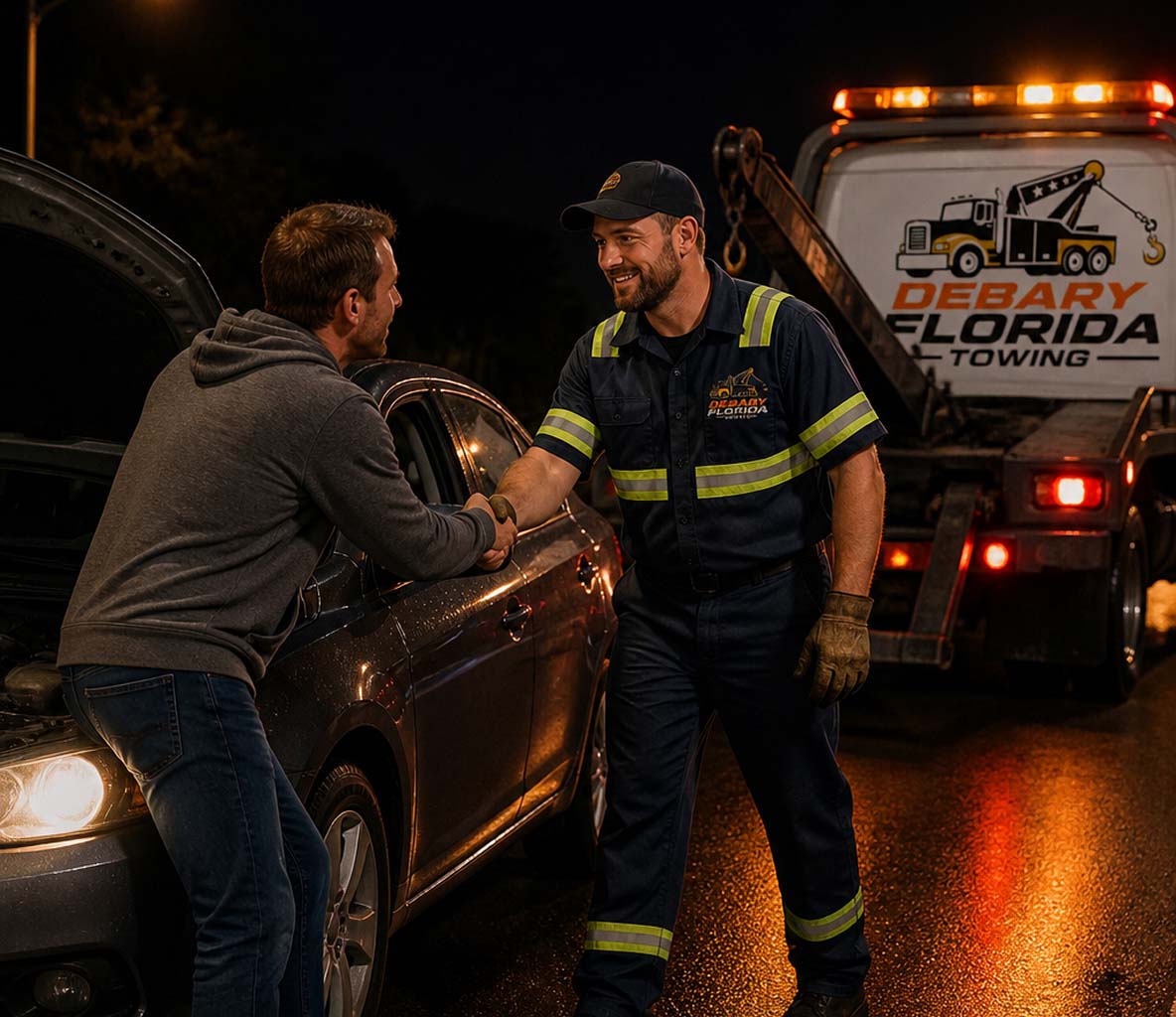
When a tire lets go, everything in you says brake and steer away from the pull. Doing the opposite, holding the wheel straight, easing off the gas, and letting the car coast down before you touch the brakes, is what keeps a blowout from becoming a crash. The rest is bought ahead of time: a monthly pressure check, an honest look at the tread, and tires retired before they get old cost far less than a spun car on I-4. Know before you pull out of the driveway whether you have a sound spare and the tools to use it, because that one answer decides whether a blowout is a short delay or a long night on the shoulder. If you are stopped near DeBary with a bad tire and no safe way to change it, DeBary Towing's roadside assistance can bring a tire change to you, and flatbed towing can carry the car in when the tire, or the wheel, is past a roadside fix.