
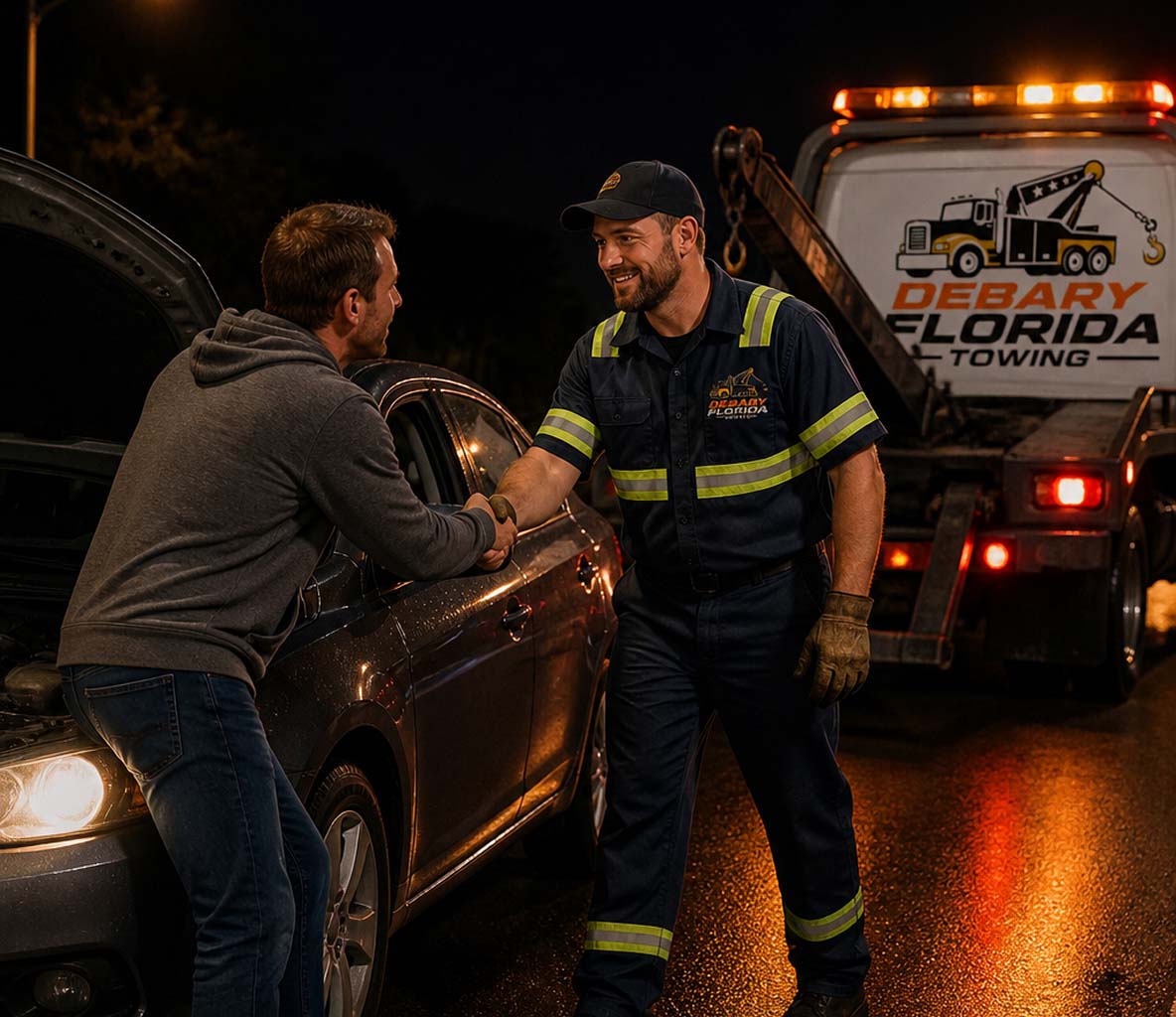
A breakdown on Interstate 4 rarely happens somewhere convenient. One minute you are rolling with traffic toward the St. Johns River bridge; the next you are coasting onto a narrow shoulder with cars passing a few feet from your door. In DeBary the same thing plays out on US 17-92, at the Dirksen Drive interchange, and on the ramps near Saxon Boulevard. What you do in the first two minutes matters more than anything a tow truck can do later.
This guide walks through the steps that keep you safe when your car breaks down on a Central Florida highway, in the order they actually matter. None of it needs tools or mechanical skill, just a clear head and a plan you can recall when your pulse is up.
- Get the car as far right as you can and off the travel lane before you stop, even on a flat tire.
- Turn on your hazard lights the moment you lose power or control, not after you have parked.
- On a fast highway, staying buckled inside the car is usually safer than standing on the shoulder.
- Florida's Move Over law requires other drivers to change lanes or slow down for your disabled vehicle.
- Know your location by mile marker, exit, or cross street and your direction of travel before you call.
- Call a local company that already runs I-4 and US 17-92 so the driver can reach you fast.
Steer Toward the Shoulder Before You Lose Momentum
The safest place for a disabled car is completely off the traveled lanes, so your first job is to use whatever speed you have left to get there. When an engine dies or a tire blows on I-4, coast to the right shoulder rather than braking hard in the lane. Signal, check your mirror, and let the car roll onto the paved shoulder or, better, past it onto the grass where there is more room. Florida law recognizes how dangerous a stopped car is in a live lane: section 316.194 of the Florida Statutes requires drivers to leave an unobstructed path for passing traffic and a clear view of the stopped vehicle from at least 200 feet in each direction, with a narrow exception for cars that truly cannot be moved.
Straight, open stretches give you that sightline; blind spots do not. If you have any control left, avoid stopping on the St. Johns River bridge, inside the Dirksen Drive interchange, or on a curve where drivers will not see you until the last second. A few hundred extra feet of coasting can put you somewhere a tow operator can safely pull in behind you.
Make Yourself Impossible to Miss
Once you are stopped, the goal is to be seen from as far away as possible. Turn on your hazard lights immediately, ideally the instant you feel the car fail. At night or in the rain, that one habit changes everything on an unlit stretch of US 17-92. If you carry reflective triangles or flares and can place them safely well behind the car, do it; if traffic is heavy and fast, do not risk stepping into the lane to set them out.
Turn your front wheels toward the shoulder, so a rear impact is less likely to shove your car into moving traffic. Florida's Move Over Act, section 316.126, requires approaching drivers to vacate the nearest lane or slow well below the posted speed as they pass a disabled vehicle. You cannot count on every driver obeying it, though, so build your own margin of safety first and treat the extra room as a bonus, not a guarantee.
Decide Whether to Stay In the Car or Get Out
On a busy highway shoulder, the safest spot is usually inside your vehicle with your seat belt fastened. The edge of I-4 is one of the worst places a person can stand, and a large share of breakdown injuries happen to people who stepped out of the car. If your vehicle is off the road and traffic is close, stay buckled, keep the hazards on, and wait for help to come to you.
There are real exceptions. If the car is on fire, filling with smoke, or still sitting partly in a travel lane where it is likely to be struck, get everyone out on the side away from traffic and move well clear of the road, behind a guardrail or up an embankment if one is there. Florida Statute 316.071 requires drivers to move a disabled vehicle out of the flow of traffic when they can, or to get help doing so, precisely because a blocked lane is so hazardous to everyone.
Pin Down Exactly Where You Are
Help arrives faster when you can say precisely where you are, so work that out before you dial. On the interstate, look for the small green mile-marker signs and note the nearest number and your direction of travel. On surface roads like US 17-92 or DeBary Avenue, use the last cross street you passed. Your phone's map app can also read out a street address or a set of coordinates if you are unsure.
Direction matters as much as location. Telling a dispatcher you are on I-4 westbound past Dirksen Drive, rather than just on I-4, can save real time, because the two shoulders run opposite ways and there is no quick turnaround on an interstate. Volusia County covers a lot of ground, and the quickest response comes from a driver who already knows which ramp lands closest to you.
Call Help That Knows These Roads
Who you call shapes how long you wait. A national roadside line routes your request to whichever contractor is free, which can mean a long hold and a driver who does not know the area. A local towing company that runs I-4, US 17-92, and the DeBary side streets every shift can often place you from a cross street alone and head straight for the correct shoulder.
When you call, give your location and direction, the type of vehicle, and what happened, a flat, a dead engine, an overheating warning, or a crash. That tells the company whether to send a standard tow, a flatbed for an all-wheel-drive or lowered car, or roadside help that may fix the problem where you sit. If the trouble is only a dead battery, a flat, or an empty tank, roadside assistance may get you moving again without a tow at all.
Common Mistakes That Turn a Breakdown Into a Crash
A few habits make a bad situation worse, and they are worth knowing before you are in one. The most common is stopping in a travel lane to check a warning light or a strange noise instead of first reaching the shoulder; a car parked in live traffic is far more dangerous than whatever the dashboard is telling you. Another is standing at the driver's door or in front of the car to wait, which puts you exactly where a distracted driver will drift.
Drivers also lose time by not knowing where they are, giving a dispatcher a vague I-4 with no direction or marker. Some try to change a tire on the traffic side of the car on a fast shoulder, which is far riskier than waiting for a tow. And many assume a passing driver or a passing patrol will stop, then wait without ever calling for help. Make the call early, stay put, and let the professionals come to a location you can name.
The First Move That Keeps You Safe
If you remember one thing, make it this: get the car out of the travel lane with your hazards on before you do anything else, then stay buckled inside unless the vehicle itself is unsafe. Placing triangles, finding your mile marker, and choosing who to call all get easier once you are out of harm's way. Central Florida traffic moves fast, and the shoulder is no place to weigh your options.
When you are safely stopped and need a lift, a crew that already works these corridors reaches you sooner. DeBary Towing runs 24/7 emergency towing and on-the-spot roadside assistance across DeBary and Volusia County, so one call from the shoulder is usually all it takes.